Protein Ingredient Stability Explained
Protein ingredient stability refers to how well a protein ingredient maintains its defined physical and chemical characteristics over time under appropriate storage conditions.
Stability focuses on predictable behavior during storage, handling, and formulation rather than biological performance after consumption.
This article explains protein ingredient stability using neutral, foundational language. The emphasis remains on structural integrity, environmental influence, and quality control processes rather than claims or recommendations.
What Protein Ingredient Stability Means
Stability describes resistance to change within defined environmental ranges.
For protein ingredients, stability most often concerns:
• Moisture balance
• Flow behavior
• Color consistency
• Odor neutrality
• Structural integrity
Stable ingredients maintain consistent characteristics throughout their intended shelf life when stored properly.
Instability does not automatically indicate contamination or degradation. It refers to measurable shifts in physical behavior that may affect handling or blending performance.
Protein ingredient stability focuses on storage behavior rather than digestion or amino acid structure.
Environmental Factors That Influence Stability
Protein powders are sensitive to environmental conditions.
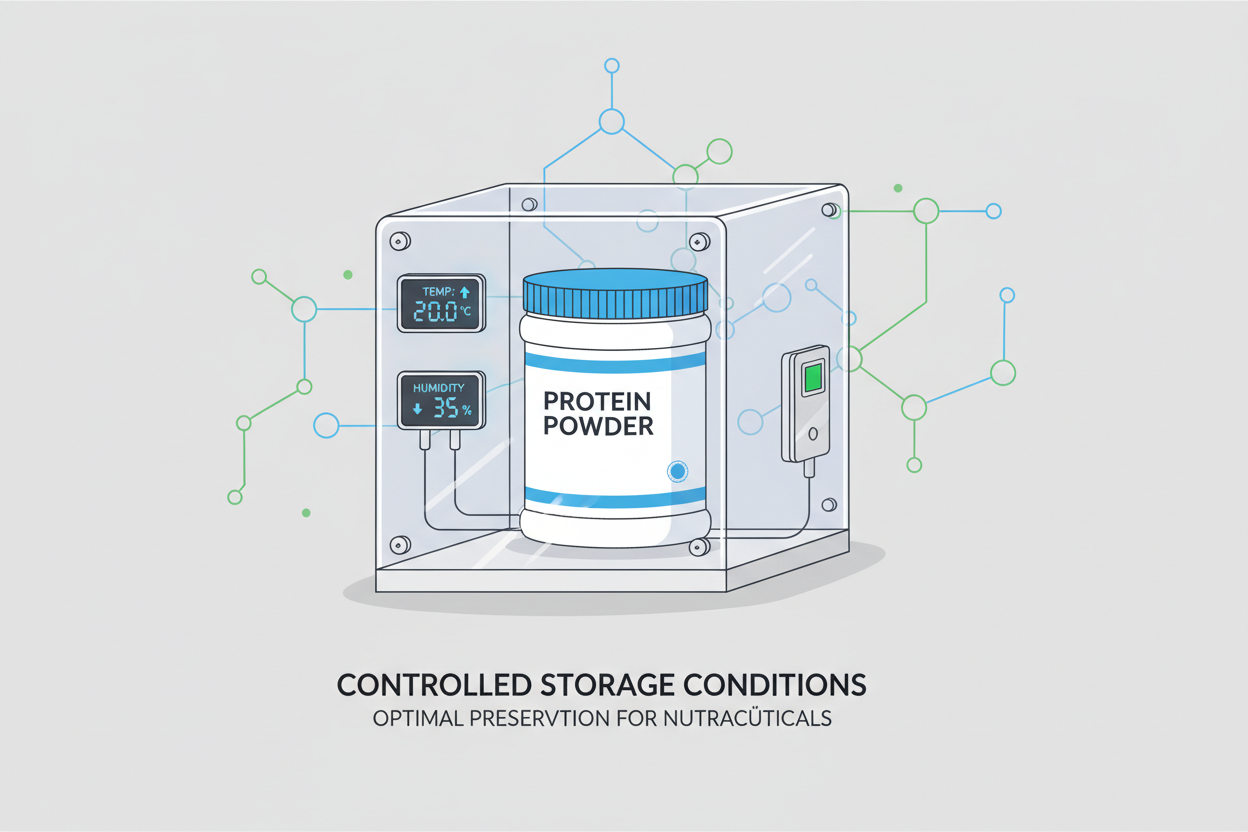
Moisture is one of the most influential variables. Many powdered ingredients are hygroscopic, meaning they can absorb water from the surrounding air. Increased moisture may alter texture, clumping behavior, and flow.
Temperature also affects stability. Elevated storage temperatures can accelerate minor oxidative processes in associated compounds. While protein structure itself remains intact under recommended conditions, related components may experience gradual shifts.
Oxygen exposure and light can also influence ingredient behavior over time. Packaging materials are often selected based on their barrier properties to limit environmental impact.
Environmental control plays a central role in maintaining predictable storage outcomes.
Structural Characteristics and Stability
The inherent structure of a protein ingredient contributes to its stability profile.
Particle size distribution, porosity, and residual moisture from processing influence how protein interacts with humidity and temperature.
Uniform drying and controlled processing parameters support predictable stability performance. Ingredients with consistent particle characteristics tend to exhibit more stable flow and blending behavior over time.
Stability therefore reflects both environmental conditions and structural attributes.
Maintaining defined ranges across these variables supports consistent ingredient handling.
Stability Testing and Shelf Life
Manufacturers evaluate protein ingredient stability through structured testing protocols.
Samples are stored under defined temperature and humidity conditions for specified durations. During testing, physical properties such as moisture, color, odor, and flow behavior are monitored against established specifications.
Accelerated stability testing may also be conducted. This approach exposes ingredients to elevated conditions for shorter time periods to simulate long term storage effects.
Shelf life represents the time during which an ingredient remains within specification limits when stored as recommended.
Stability testing focuses on physical integrity and handling consistency rather than biological performance.
Why Stability Matters in Manufacturing
Stable protein ingredients support predictable formulation outcomes.
When stability is maintained, powders flow consistently, blend evenly, and behave reliably during packaging and transport. Instability may introduce variability in mixing, measuring, or storage conditions.
For end users, stability primarily influences storage behavior rather than nutritional composition. Proper storage in cool, dry environments helps maintain ingredient integrity throughout its usable life.
Stability works alongside variability, consistency, and processing controls as part of the broader protein ingredient lifecycle.
How This Fits Into Protein Fundamentals
Protein Fundamentals explains how protein moves from sourcing through processing and into finished form.
Protein ingredient stability represents the storage stage of that lifecycle. It clarifies how environmental conditions influence physical behavior without altering amino acid identity.
Understanding stability adds context to discussions of variability, processing, and shelf life while maintaining clear separation between structural handling and biological digestion.
Part of the Nutrition Foundations Series
This article is part of our Nutrition Foundations series, where we explain how macronutrients are sourced, processed, stored, and handled before consumption.
Visit the Nutrition Foundations hub to explore more articles in this series.
Related Articles in This Series
Protein Ingredient Variability Explained
Protein Ingredient Consistency Explained
Ingredient Processing and Digestibility
Digestibility Differences Between Protein Sources
Protein Ingredient Shelf Life Explained
About Earth Fuel
Earth Fuel is built around one principle: simple protein. Nothing extra. We focus on clear formulation, ingredient transparency, and structural integrity across every stage of the protein lifecycle. Learn more about our approach and formulation philosophy on the
Earth Fuel homepage
Frequently Asked Questions
Q: What does protein ingredient stability refer to
A: It refers to how well a protein ingredient maintains defined physical characteristics during storage.
Q: Does stability affect amino acid composition
A: No. Stability concerns physical behavior rather than amino acid sequence.
Q: What is the main factor influencing stability
A: Moisture exposure is one of the most influential environmental factors.
Q: Is shelf life the same as stability
A: Shelf life is determined through stability testing under recommended storage conditions.
Q: Does instability mean a product is unsafe
A: Instability refers to measurable changes in physical behavior and does not automatically indicate safety concerns.
Q: Can packaging affect stability
A: Yes. Packaging materials influence exposure to moisture, oxygen, and light.

Written by Earth Fuel