Ingredient Interactions in Protein Powders
Ingredient interactions refer to how different components within a protein powder formulation influence one another’s physical behavior. These interactions occur during mixing, storage, and handling and are primarily structural rather than biological.
This article explains ingredient interactions in protein powders using neutral, foundational language. The focus remains on manufacturing behavior and formulation structure rather than claims or recommendations.
What Ingredient Interactions Mean
Protein powders often contain more than one component.
In addition to protein itself, formulations may include flavor systems, sweeteners, stabilizers, or flow agents. When multiple ingredients are combined, their physical properties can influence one another.
Ingredient interactions describe how these components behave when blended together.
These interactions may affect:
• Flow characteristics
• Texture
• Clumping behavior
• Moisture retention
• Mixing properties
The interaction is physical rather than nutritional.
Protein as a Structural Base
Protein powder functions as the structural base of the formulation.
Protein particles have defined size, density, and surface properties. When other ingredients are added, they attach to or distribute among these particles.
The way these components disperse depends on particle size compatibility, moisture levels, and electrostatic characteristics.
Uniform blending requires careful formulation control.
Moisture and Hygroscopic Behavior
Some powdered ingredients attract moisture from the surrounding environment. This property is known as hygroscopic behavior.
When hygroscopic ingredients are combined with protein powder, they can influence:
• Clumping tendencies
• Shelf stability
• Flow behavior
Moisture migration between ingredients may alter physical texture over time.
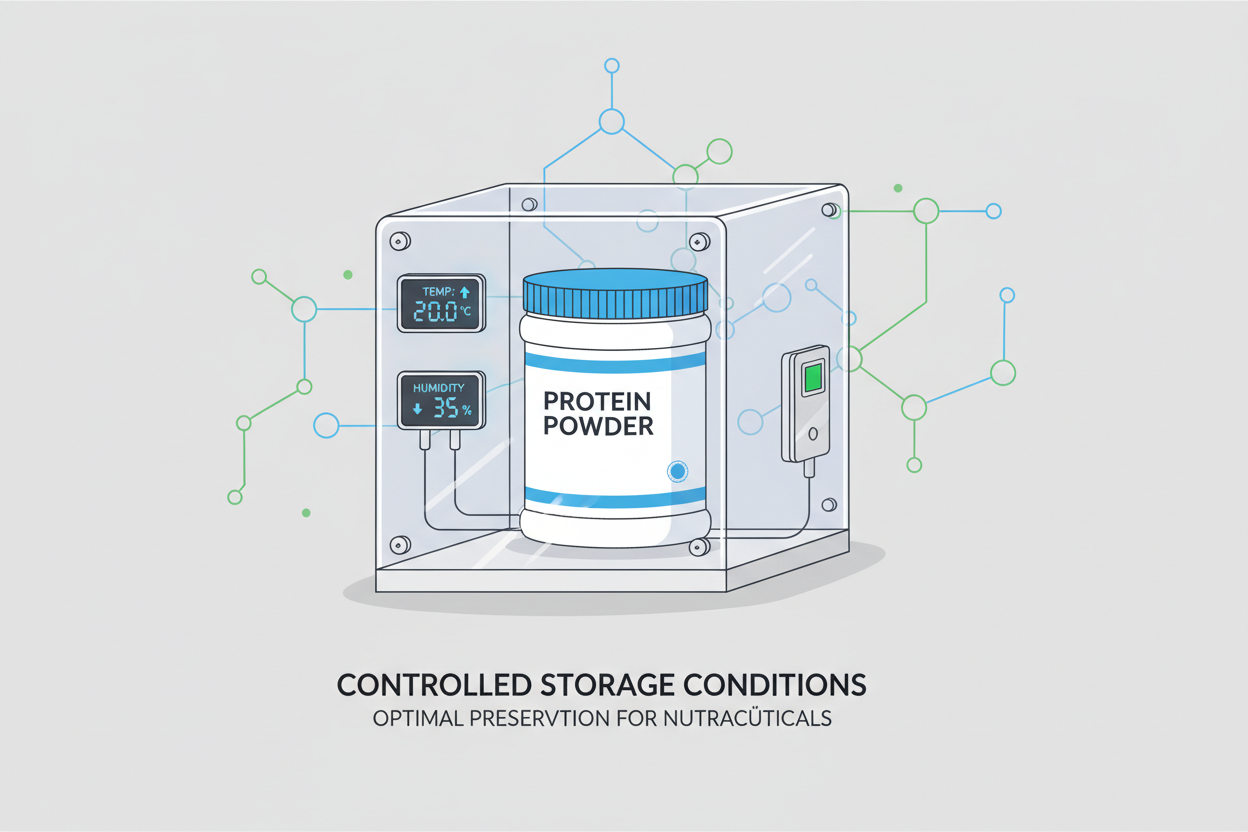
Managing these interactions requires control of humidity and packaging conditions.
Particle Size and Density Differences
Ingredient interactions are also influenced by particle size and density.
If one ingredient has significantly smaller particles than another, separation may occur during transport or handling. This phenomenon is sometimes referred to as segregation.
Uniform particle distribution supports consistent mixing behavior.
Matching particle characteristics helps reduce separation during storage.
Stabilizers and Structural Modifiers
Some formulations include stabilizers or thickening agents.
These components interact with protein during mixing by influencing water absorption and viscosity. Structural modifiers change the physical behavior of the mixture without altering amino acid composition.
These interactions are mechanical rather than biological.
Understanding these structural relationships clarifies why different protein powders behave differently during preparation.
Flavor Systems and Interaction Effects
Flavor systems are composed of multiple compounds.
When blended with protein, flavor compounds interact with protein surfaces. These interactions may influence taste perception and aroma release.
Protein binding can slightly alter how flavor compounds are experienced during consumption.
These interactions remain structural and sensory rather than nutritional.
Ingredient Interactions Do Not Change Protein Identity
Ingredient interactions do not alter the molecular identity of protein.
Amino acid sequences remain unchanged. Interactions influence physical behavior, not biological composition.
Separating structural interaction from biological function helps maintain clarity in protein discussions.
How This Fits Into Protein Fundamentals
Protein Fundamentals explains how ingredients behave from sourcing through formulation.
Ingredient interactions represent the formulation stage of the protein lifecycle. They describe how multiple components function together in powdered systems.
Understanding interactions adds context to discussions of variability, consistency, processing, and stability.
The explanation remains focused on structural and handling principles.
Part of the Nutrition Foundations Series
This article is part of our Nutrition Foundations series, where we explain how macronutrients and related ingredients behave during processing and preparation.
👉 Visit the Nutrition Foundations hub to explore more articles in this series.
Related Articles in This Series
Protein Ingredient Variability Explained
Protein Ingredient Consistency Explained
Ingredient Processing and Digestibility
Digestibility Differences Between Protein Sources
Protein Ingredient Stability Explained
About Earth Fuel
Earth Fuel is built around one principle: simple protein. Nothing extra. We focus on clear formulation, ingredient transparency, and structural integrity across every stage of the protein lifecycle. Learn more about our approach and formulation philosophy on the
Earth Fuel homepage
Frequently Asked Questions
Q: Do ingredient interactions change amino acids
A: No. Interactions affect physical behavior, not amino acid sequence.
Q: Why do some protein powders clump more than others
A: Differences in moisture interaction and particle size can influence clumping behavior.
Q: Are ingredient interactions harmful
A: Interactions describe physical behavior and are not inherently harmful.
Q: Can particle size affect mixing
A: Yes. Differences in particle size can influence dispersion and uniformity.
Q: Does flavor interact with protein
A: Flavor compounds may bind to protein surfaces, influencing sensory perception.
Q: Do interactions affect digestion
A: This article focuses on formulation behavior rather than digestion.

Written by Earth Fuel