How Protein Ingredients Affect Mixability
Mixability refers to how easily a protein powder disperses and blends when combined with liquid. Protein ingredients play a central role in determining mixability because their structural and physical characteristics influence how the powder interacts with water during preparation.
This article explains how protein ingredients affect mixability using neutral, foundational language. The focus remains on physical behavior, particle properties, and formulation structure rather than performance claims.
What Mixability Means
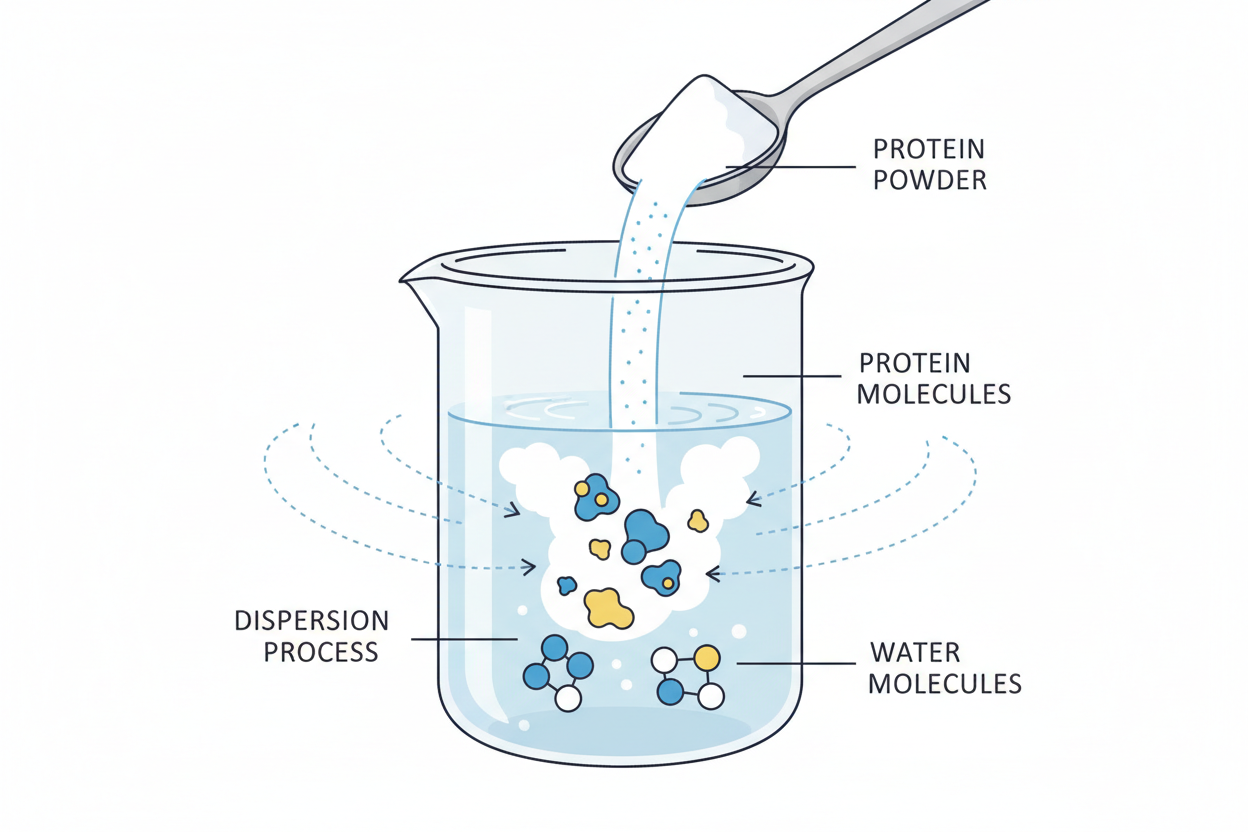
Mixability describes the ease with which a powdered ingredient disperses into a liquid without forming excessive clumps or sediment.
It involves several observable characteristics:
• Speed of dispersion
• Uniformity of suspension
• Resistance to clumping
• Smoothness of texture
Mixability is not identical to solubility. Solubility refers to how a substance dissolves at a molecular level. Mixability refers to how the powder behaves physically during agitation and blending.
Protein ingredient characteristics significantly influence this behavior.
Particle Size and Distribution
Particle size is one of the most important factors affecting mixability.
Smaller particles typically disperse more easily because they have greater surface area relative to their volume. However, extremely fine particles may become cohesive in the presence of moisture, increasing the likelihood of clumping.
Uniform particle size distribution helps ensure even dispersion. When particles vary widely in size, separation may occur during storage, which can influence how the powder mixes later.
Controlled milling and drying processes help maintain consistent particle behavior.
Surface Characteristics and Water Interaction
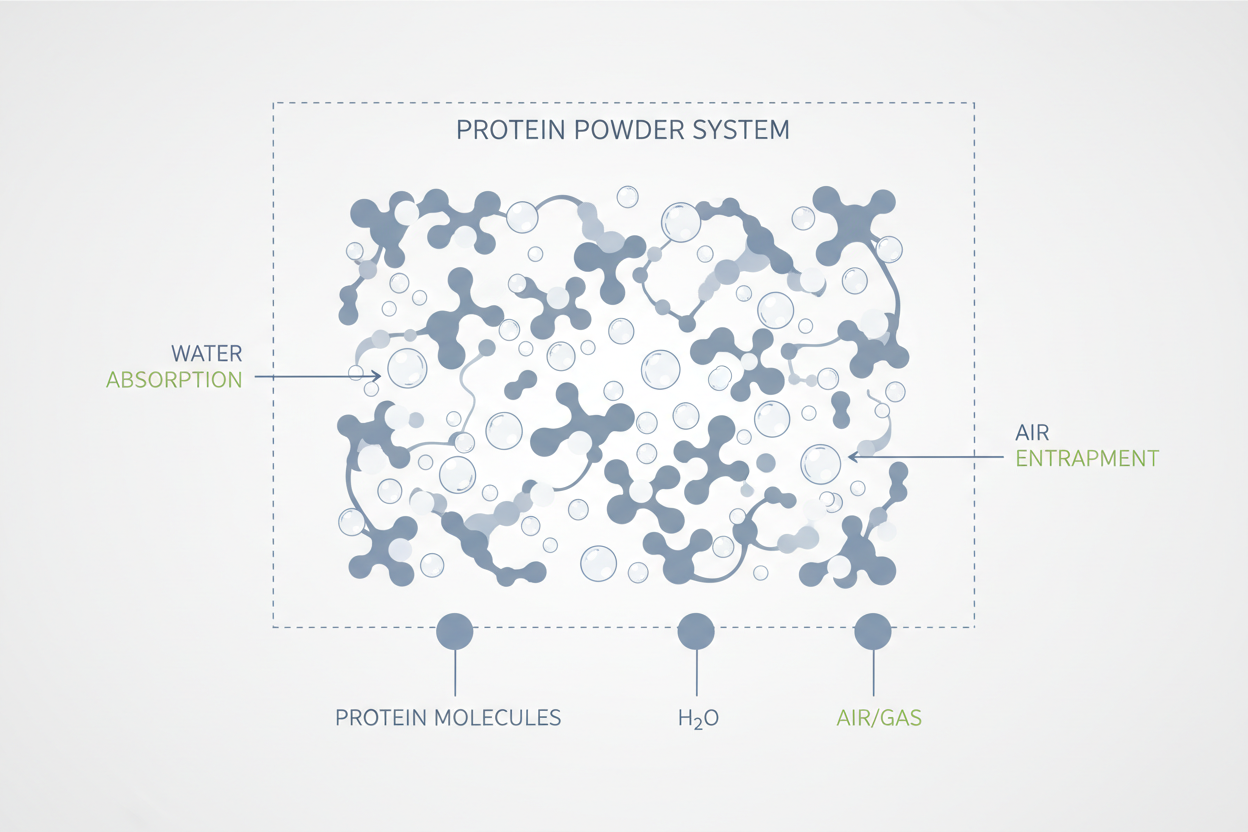
The surface properties of protein particles affect how they interact with water.
Hydrophilic regions of the protein structure attract water molecules, while hydrophobic regions repel them. The balance between these regions influences how quickly water penetrates and disperses the powder.
Processing methods may alter surface exposure and therefore influence mixability.
Moisture content also plays a role. Slight increases in ambient moisture may promote particle adhesion, reducing dispersion efficiency.
Mixability therefore reflects both inherent structural characteristics and storage conditions.
Role of Formulation Components
Protein is often combined with other ingredients in a finished powder.
Flow agents, flavor systems, and structural modifiers may affect how the overall mixture disperses. Matching particle size and density across ingredients supports uniform mixing behavior.
If one component is significantly denser or finer than the others, segregation during transport may influence mixability performance at the time of use.
Managing these relationships supports consistent blending.
Agitation and Preparation Variables
Mixability is also influenced by preparation method.
Manual shaking, spoon stirring, and mechanical blending each produce different levels of agitation. Liquid temperature can also influence dispersion speed.
These variables affect observable mixing performance but do not change amino acid composition or biological properties.
Understanding the structural factors behind mixability helps clarify why preparation experiences may vary between products.
How This Fits Into Protein Fundamentals
Protein Fundamentals explains how structural properties influence ingredient behavior before digestion.
Mixability represents the consumer preparation stage of the protein lifecycle. It connects discussions of solubility, particle size, variability, and ingredient interactions.
Understanding mixability reinforces the broader concept that protein powders are physical systems governed by structural principles rather than marketing descriptors.
Part of the Nutrition Foundations Series
This article is part of our Nutrition Foundations series, where we explain how protein ingredients behave during processing, storage, and preparation.
Visit the Nutrition Foundations hub to explore more articles in this series.
Related Articles in This Series
Protein Ingredient Solubility Explained
Protein Ingredient Function in Protein Powders
Ingredient Interactions in Protein Powders
Protein Ingredient Variability Explained
Protein Ingredient Stability Explained
About Earth Fuel
Earth Fuel is built around one principle: simple protein. Nothing extra. We focus on clear formulation, ingredient transparency, and structural integrity across every stage of the protein lifecycle. Learn more about our approach and formulation philosophy on the
Earth Fuel homepage
Frequently Asked Questions
Q: Is mixability the same as solubility
A: No. Solubility refers to molecular dissolution, while mixability refers to physical dispersion behavior.
Q: Does particle size affect mixability
A: Yes. Particle size and distribution influence how evenly a powder disperses in liquid.
Q: Can storage conditions affect mixability
A: Yes. Moisture exposure may increase clumping and alter dispersion behavior.
Q: Do other ingredients influence mixability
A: Yes. Formulation components and particle compatibility affect blending behavior.
Q: Does mixability affect amino acids
A: No. Mixability concerns physical behavior, not amino acid composition.
Q: Is blender use necessary for proper mixing
A: Mechanical blending increases agitation, which may improve dispersion compared to manual stirring.

Written by Earth Fuel